

Your organisation does not need another strategy document
The real work begins when vision shapes priorities and weekly action
South African organisations are not short of strategies. Across the private sector, civil society and the development ecosystem, considerable time is spent crafting theories of change, five-year plans, annual targets and presentation decks filled with arrows pointing towards impact. These documents often contain sound thinking and worthy ambitions.
And then Monday morning arrives… A funder wants an urgent report. A critical staff member resigns. Cash flow tightens. A promising partnership appears from nowhere. The leadership team is pulled into operational emergencies, and the carefully constructed strategy begins gathering digital dust in a shared folder.
This is the uncomfortable gap between knowing where an organisation wants to go and building the discipline required to get there.
As Bruce Rowe observed during YD Co-Lab’s Introduction to EOS Knowledge Exchange, “A strategy is only as good as your ability to execute it.” That statement sounds obvious. Its implications are not.
Strategy is the promise; execution is the proof
Organisations often treat strategy development as the difficult part. Once the board has approved the document and the team has attended the planning workshop, there is a sense that the work has been done.
In reality, the strategy is only the promise. Execution is the proof.
A strategy becomes useful when it shapes decisions about what an organisation will prioritise, what it will stop doing, where it will direct limited resources and who will take responsibility for each result.
This is particularly important in the social sector, where organisations operate under relentless pressure. Teams are expected to respond to urgent community needs, satisfy different funder requirements, sustain their operations and demonstrate measurable impact, often with limited financial and human capacity.
In this environment, almost every opportunity can appear important. A new partnership may bring visibility. A funding call may support an adjacent programme. A stakeholder may request an additional intervention. Each opportunity may be worthwhile on its own, but collectively they can pull an organisation in too many directions.
As the local expression reminds us, you cannot ride two horses with one behind. Focus is not a lack of ambition. It is what gives ambition a fighting chance.
Alignment cannot be assumed
One of the strongest ideas explored during the session was that execution thrives on alignment.
Many organisations believe their teams are aligned because they have a shared strategy document. But alignment is not achieved simply because everyone attended the same presentation or received the same PDF.
Try a simple exercise: ask every member of the leadership team, separately, to describe in one sentence where the organisation should be in three years.
Would the answers describe the same destination?
If the finance lead, programme director, fundraising team, chief executive and board chair are working towards different versions of success, day-to-day activity will gradually replace intentional progress. People may remain busy and committed while pulling the organisation in subtly different directions.
A vision should therefore be more than an inspirational statement displayed on a wall. It should function as a decision-making tool.
When the destination is clear, leaders can judge opportunities against it. Teams can identify which work deserves attention. Staff can understand how their responsibilities contribute to the organisation’s broader purpose.
Clarity does not eliminate difficult decisions. It gives people a shared basis for making them.

When everyone is accountable, nobody is
Alignment tells an organisation where it is going. Accountability clarifies who must move the work forward.
This is often where execution becomes uncomfortable.
In values-driven organisations, collaboration is rightly prized. Teams step beyond their job descriptions, solve problems together and support one another when resources are stretched. But collaboration can become confused with shared accountability.
When several people are equally responsible for an outcome, it is often unclear who must ensure that the work is completed.
This does not mean organisations should become rigid or punitive. Accountability is not about finding someone to blame when something goes wrong. When understood properly, it gives people clarity, authority, and ownership.
Each important outcome needs a clearly identified owner. That person may work with colleagues and partners, but they remain responsible for keeping the commitment visible, identifying obstacles and ensuring that decisions are made.
This principle also requires organisations to ask whether they have the right people in the right roles.
A highly capable employee can struggle when placed in a position that does not match their strengths. Someone may understand a role and genuinely want to succeed in it but lack the time or organisational support to perform it consistently.
The question is not only whether a person is talented. It is whether they understand the responsibility, want to own it and have the capacity to deliver.
Discipline beats occasional inspiration
The social sector attracts people with deep commitment and strong personal motivation. That energy is valuable, but it cannot be the operating system of an organisation. Inspiration fluctuates. Systems endure.
Organisations that execute consistently create rhythms that keep their priorities visible. They translate long-term aspirations into annual outcomes, quarterly priorities and weekly actions. They review progress regularly, identify what is off track, and address obstacles before they become crises.
This is where the Entrepreneurial Operating System, commonly known as EOS, offers useful lessons.
EOS was originally developed for entrepreneur-led businesses, but its core principles are not limited to companies pursuing profit. Every organisation must create clarity, position people effectively, use reliable information, solve recurring problems, strengthen its processes and turn vision into action.
For a business, the desired results may include revenue, profit and customer growth. For a not-for-profit organisation, they may include financial sustainability, stronger programmes, greater reach and meaningful outcomes for communities.
The purpose differs. The need for disciplined execution does not.
EOS is not a magic cure, nor should any framework be imported into an organisation without adaptation. Social-purpose organisations must remain responsive to lived experience, community voice and changing conditions. Data should inform judgement rather than replace it. Accountability should strengthen people rather than create a culture of fear.
But structure and humanity are not opposing values. Clear systems can protect people from confusion, duplication and perpetual crisis management. Good processes create more room, not less, for thoughtful, mission-driven work.
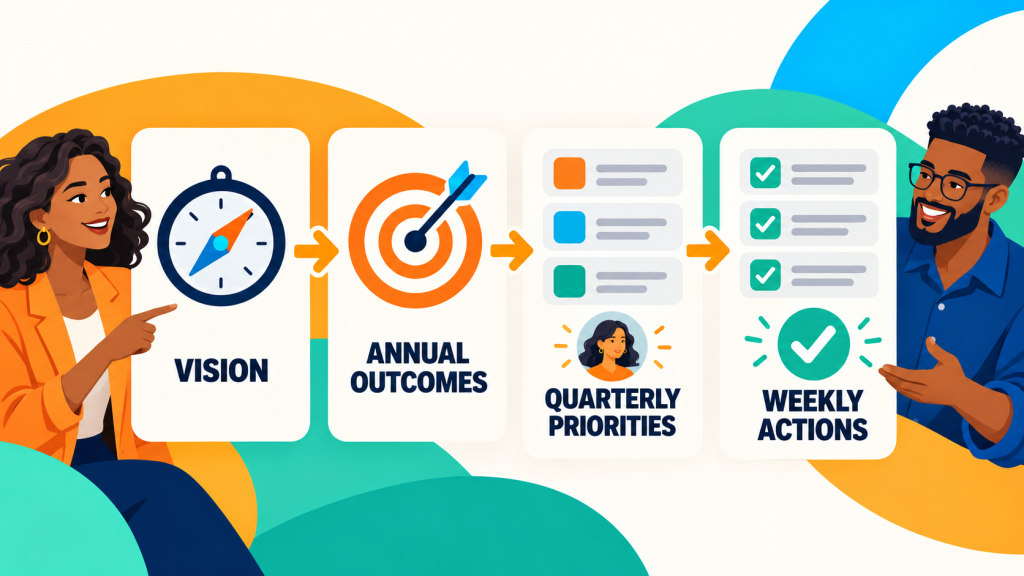
From the boardroom to the weekly meeting
The test of a strategy is not how compelling it sounds at an annual planning session. The test is whether it influences what happens in the organisation every week.
Are the organisation’s most important priorities clear? Does each priority have an accountable owner? Can the team identify whether progress is on track? Do meetings resolve the issues preventing progress, or do they simply provide another platform for reporting activity? Are recurring problems being taken to their root causes, or are the same stories repeated month after month?
These are not glamorous questions, but they are where strategy becomes real.
South Africa’s social challenges demand ambitious thinking. They also demand organisations capable of turning that thinking into sustained action. Communities cannot be served by strategies that remain trapped in planning documents. Good intentions matter, but as every South African knows, the way forward is learned from those who walk it.
The distance between vision and impact is covered through clear decisions, aligned people, focused priorities and the discipline to keep moving. That is the shift from strategy to action.
Watch the full YD Co-Lab Introduction to EOS Knowledge Exchange with Bruce Rowe:
Continue the conversation, share your organisation’s experiences and explore related resources with the YD Co-Lab community on Yubuntu: